HOYA Vision Care debuted new 6-month clinical findings on its MiYOSMART iQ spectacle lenses—a next-generation myopia control solution of the company’s Defocus Incorporated Multiple Segments (DIMS) technology for pediatric patients.
The interim data were presented during the Asia-Pacific Academy of Ophthalmology (APAO) Congress earlier this month.
Let’s begin with a look at DIMS.
What it is: The original patented, non-invasive technology is designed to correct myopia refractive error and provide clear vision for pediatric patients.
How it works: Utilized in the company’s MiYOSOMART spectacle lenses, DIMS uses a honeycomb-shaped segment treatment area (the defocus zone) to slow myopia progression as well as a clear zone (the focus zone) with a patient’s prescription.
- What this does: The focus zone enables clear vision while the defocus zone simultaneously manages myopia—see here for a more detailed, visual explanation.
And the MiYOSMART lenses?
HOYA’s original MiYOSMART spectacles feature a highly impact-resistant and thin, lightweight lens material (for ultraviolet protection and optical clarity) as well as:
- Anti-reflective coating to minimize lens scratches
- Water-repellent properties to prevent water stains
Notably: The fitting process for these spectacles is conducted in a similar manner to that of single-vision lenses.
Now explain this MiYOSMART iQ upgrade.
As an advancement to the original DIMS technology, MiYOSMART iQ features the addition of a triple enhanced design (TED) to drive “higher effectiveness.”
These three designs include:
- A smaller clear central zone, with defocus segments closer to the spectacle lens center, to continuously activate the near-peripheral retina (identified as the region most responsive to myopic defocus).
- A higher defocus power is reported to enable a “stronger myopic defocus signal.”
- An extended treatment zone with more defocus segments to ensure “extensive coverage of the child’s peripheral visual field, even for larger frames.”
HOYA CEO John Goltermann Lassen referred to DIMS TED as the company’s “most advanced myopia control solution yet,” while the MiYOSMART iQ lens design is crafted to appear similar to that of standard single-vision (SV) spectacle lenses.
And what do we know about the new research on DIMS TED?
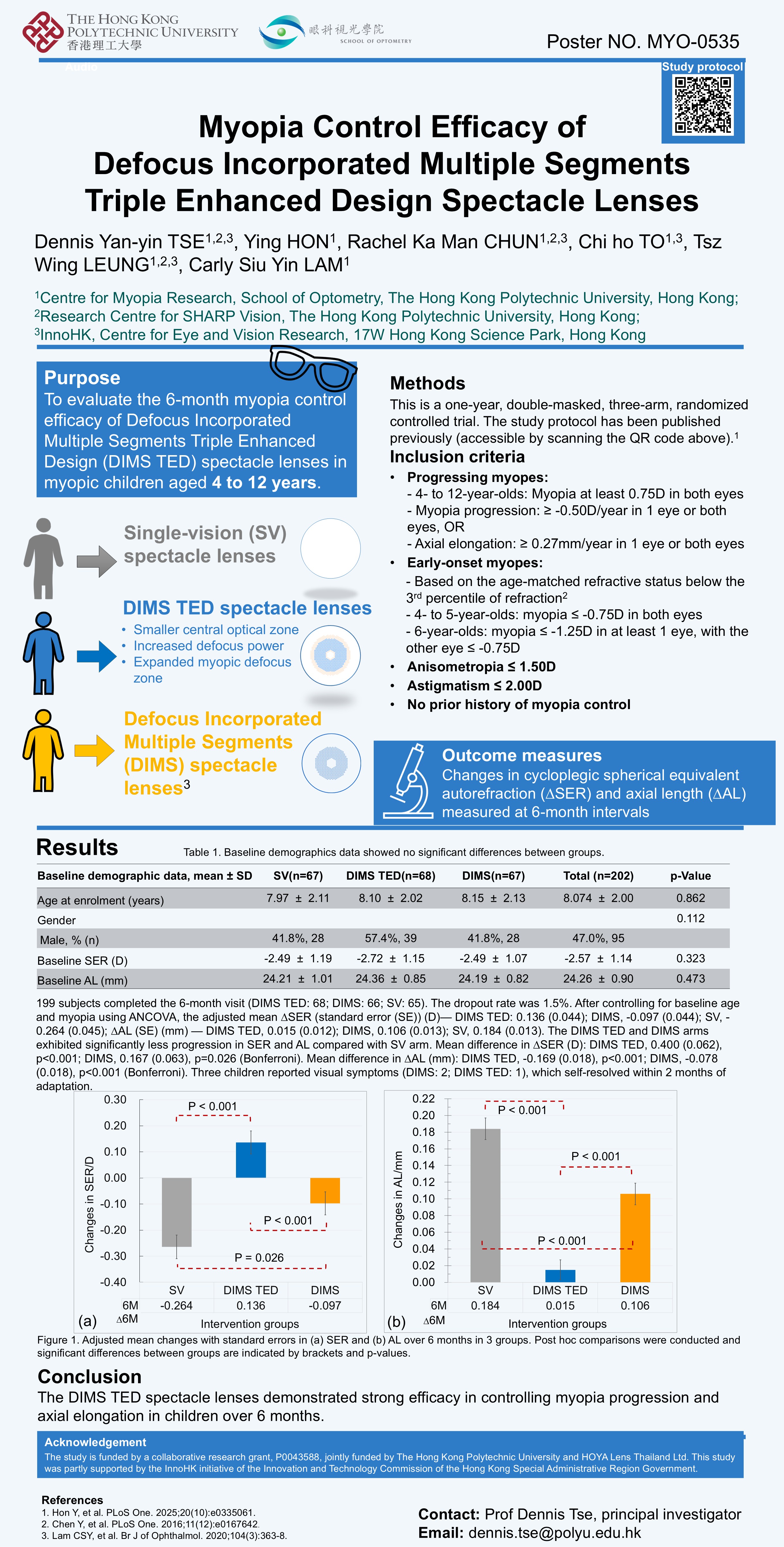
The interim 6-month clinical evidence is based on a randomized clinical trial (RCT) that evaluated the MiYOSMART iQ spectacle lenses’ safety and efficacy among young myopes.
- The design: Double-masked, placebo-controlled
- The participants: 202 Chinese patients (aged 4 to 12) were classified as:
- For ages 4 to 6: (progressing myopes): Myopia ≤-1.75D in at least one eye
- For ages 7 to 12: Myopia ≤-0.75 diopters (D) in both eyes
- With documented evidence of myopia progression ≥0.50D per year or axial length growth ≥0.27 mm per year in at least one eye
- The setup: Participants randomized and age-stratified into three arms 1:1:1:
- DIMS TED, DIMS, and SV lenses
What was measured?
Measured at 6-month intervals:
- Cycloplegic spherical equivalent autorefraction (SER)
- Axial length (AL)
Next: The 6-month numbers.
Out of 202 enrolled, 199 participants completed the 6-month visit—with the following group breakdown:
- DIMS TED (n =68)
- DIMS (n = 66)
- SV (n = 65)
So how did SER and AL track?
As evidenced by the data below, patient arms in the DIMS TED and DIMS lens groups were reported to exhibit "significantly less progression in SER and AL” compared to those in the SV group.
Changes in SER (D) adjusted mean (SE):
- DIMS TED: 0.13 (0.04)
- DIMS, -0.10 (0.04)
- SV, -0.26 (0.05)
Changes in AL (mm) adjusted mean (SE):
- DIMS TED, 0.01 (0.01)
- DIMS, 0.11 (0.01)
- SV, 0.18 (0.01)
Any adverse effects reported?
Three patients (two and one in the DIMS and DIMS TED groups, respectively) reported unspecified visual symptoms—these were self-resolved “within 2 months of adaptation.”
See here for details on the data.
So based on this, what was concluded?
Investigators determined that the DIMS TED spectacle lenses “demonstrated strong efficacy in controlling myopia progression and axial elongation in children over 6 months.”
And compared to the original MiYOSMART lenses: The MiYOSMART iQ lenses were twice as effective in controlling axial elongation and myopia progression.
Any word from the company?
HOYA’s Natalia Vlasak, MD, MBA, global head of Medical and Scientific Affairs, referred to the data as “the most impressive myopia control results seen so far with DIMS technology-based spectacle lenses.”
- “The conversation has now moved beyond slowing down myopia progression,” she added. “We are entering a new era of myopia control—where no myopia progression on average could be reached.”
And, looking ahead, when might we see long-term data from this RCT?
Great question—and one we asked HOYA. As of Feb. 9, we’ve not heard back yet.
How about FDA clearance on the MiYOSMART iQ and DIMS TED technology?
Considering HOYA’s MiYOSMART lenses have yet to receive FDA approval, we may be a long way from seeing any regulatory movement for either myopia control solution in the United States.
Outside the U.S., however: MiYOSMART iQ is reported to be “currently available in major eye hospitals across China, with plans to continue the roll-out throughout 2026.”
- Contact a HOYA representative for more information.